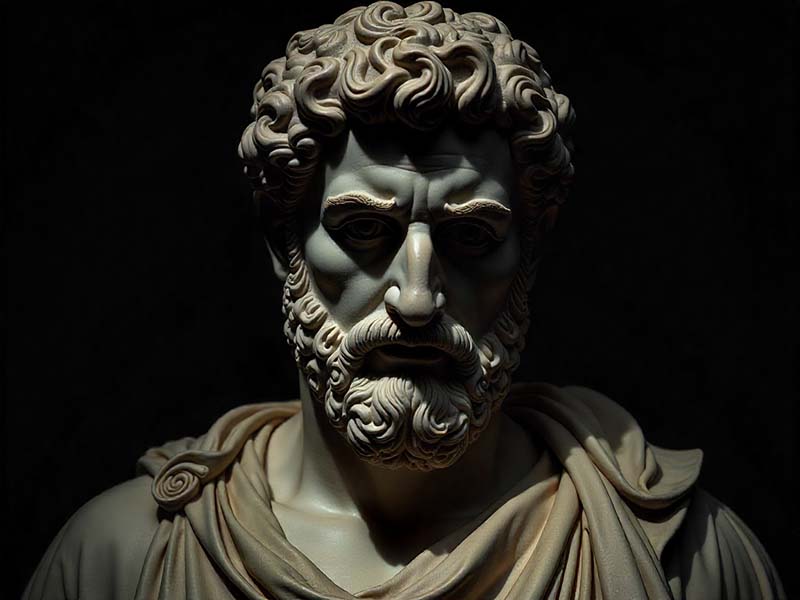
Marcus Aurelius Wasn’t Your Self-Help Crutch - He Was Your Intervention
You’ve turned Stoicism into a productivity hack. The emperor wrote in blood while his empire collapsed. It is time to choose: keep lying to your journal, or finally live what you quote.
Marcus Aurelius wrote Meditations in a war camp surrounded by plague, betrayal, and death. You are reading it on a tablet with a latte in your hand. The distance is not just historical, it is philosophical. And somewhere in that distance, something sacred has been diluted into performance.
I. The Emperor’s Reality Versus Your Cosplay
Marcus Aurelius was not a motivational speaker. He was a ruler carrying the weight of an empire on the brink of collapse. His words were not crafted for applause as they were written for survival. Every entry was a private act of discipline, a reminder to remain just, calm, and human while everything around him deteriorated.
The Antonine Plague devastated Rome, killing millions. His armies fractured, his children died, and betrayal lived within his own ranks. Yet in the middle of loss, he wrote about restraint, compassion, and inner order. Stoicism was not comfort, it was endurance under pressure that would break most men.
- Historical Reality
Marcus Aurelius governed during one of the deadliest pandemics of the ancient world. He led through famine, war, and rebellion while enduring personal grief. His philosophy was forged in crisis, not convenience. - Modern Imitation
Today, Stoicism is packaged as aesthetic minimalism and productivity culture. Quotes are layered over gym routines and hustle narratives. Endurance has been distorted into burnout, and discipline into performance. - The Inversion
As philosopher Massimo Pigliucci notes, modern Stoicism often replaces acceptance with ambition. What once cultivated humility now fuels ego. What once grounded the soul now drives the grind.
You see it everywhere, Stoicism used as permission to tolerate dysfunction. “Endure hardship” becomes justification for toxic environments. “Control what you can” becomes manipulation masked as discipline.
The emperor wrote to stay sane.
You quote him to stay relevant.
Image

II. The Three Stoic Lies You Keep Telling Yourself
It is easy to quote wisdom. It is far harder to embody it. Modern Stoicism has become an identity, something worn, not lived. The danger is not misunderstanding the philosophy. The danger is believing you understand it while avoiding its demands.
- “I Control My Reactions.”
You repeat this like a mantra, yet collapse under minor inconvenience. Stoic control was never suppression, it was awareness shaped by reason. Marcus faced betrayal and still practiced patience. You face discomfort and call your reaction discipline. It is not control, it is denial without reflection. - “Virtue Is Enough.”
You say this while chasing recognition and comfort. For the Stoics, virtue required sacrifice. It meant choosing integrity when it cost you something. Today, virtue is often decorative, a language used to justify ambition rather than restrain it. - “Memento Mori.”
You wear it, post it, aestheticize it, but do not live it. Remembering death is not symbolic. It is a recalibration of how you spend your time, your attention, your life. If death is real and it is, then your distractions are also real.
The truth is uncomfortable: you are not practicing Stoicism. You are curating it, and curation is not transformation.
Image
III. Cold Water Reality
Marcus Aurelius never intended to be quoted. His journal was not philosophy for the public as it was discipline for the self. He wrote to confront his own weakness, not to inspire admiration.
Today, Stoicism has been turned into content. And when philosophy becomes content, it risks becoming hollow. When your quotes outnumber your moments of silence, you are not practicing wisdom but performing it.
- Philosophy Was Private
For the Stoics, integrity was measured in solitude. Not in applause, not in followers, not in visibility. Truth was something you lived when no one was watching. - Performance Replaced Practice
You share wisdom publicly but avoid confronting yourself privately. The result is a polished exterior with an unexamined interior. - The Core Principle
Stoicism is not something you display. It is something you endure. Quietly. Repeatedly. Without validation.
The emperor wrote to survive the weight of his crown.
You quote him to survive your schedule.
IV. The Real Challenge
So here is your intervention. For seven days, stop quoting Stoics. Stop performing discipline. Stop curating wisdom for an audience. Instead, write your own Meditations.
- Write One Truth Daily
Each morning, write one unfiltered truth about yourself. No edits. No polish. No performance. Just honesty. - Remove the Audience
If what you write would make others uncomfortable, you are getting closer to truth. Real philosophy begins where approval ends. - Confront, Don’t Curate
Do not turn your reflections into content. Let them remain raw. Stoicism is not meant to be shared as it is meant to be lived.
Final Reflection
Stoicism is not about appearing calm, it is about becoming honest. It is not about detaching from life, it is about engaging with it fully, without illusion. Marcus Aurelius did not write to impress history. He wrote to survive reality.
And maybe that is the question left for you:
Are you using philosophy to look better or to become better? Because the difference is everything.
Image

About the Author
Dr. Mariza Lendez writes from a place of reflection shaped by discomfort, hard questions, and lived experience. She has made mistakes, taken wrong turns, and struggled with her own thinking and direction yet sees all of these as part of her learning journey. She does not claim to be a teacher, but remains a student in the university of life, continuously examining, unlearning, and growing. Her passion is to contribute meaningful value to her family and community.