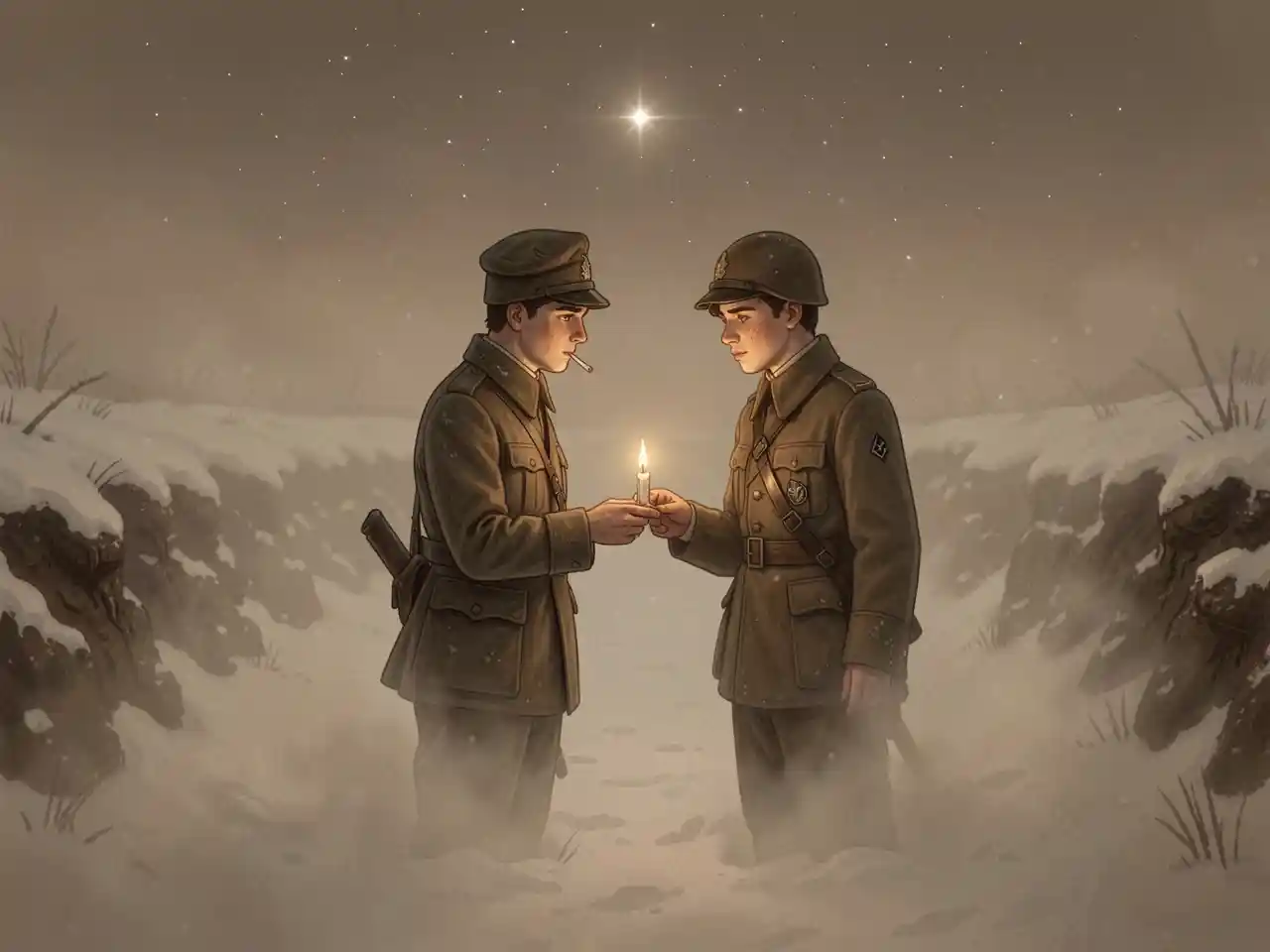
History often remembers wars through dates, victories, and losses. What it forgets sometimes deliberately are the moments when humanity interrupts violence.
One such moment occurred in December 1914, during the first winter of the First World War, when young soldiers on opposing sides of the Western Front laid down their weapons and met one another in the open space between trenches. This moment, now known as the Christmas Truce, remains one of the most profound yet underemphasized events in human history not because it ended the war, but because it revealed something essential about who we are.
The truce was not planned by governments or negotiated by generals. It was not the product of treaties, ideology, or strategy. It emerged spontaneously, from ordinary men who had been trained to kill and commanded to obey. When Christmas arrived, something older than war, stronger than fear, and deeper than authority knocked on their hearts. And they answered.
What happened: History, Not Myth
On Christmas Eve and Christmas Day of 1914, along several sections of the Western Front, British and German soldiers laid down their weapons. Accounts documented in soldiers’ letters, diaries, and later verified by institutions such as the Imperial War Museums and Encyclopedia Britannica confirm what initially seemed unbelievable: enemies climbed out of trenches, met in No Man’s Land, exchanged food and small gifts, sang carols, buried their dead together, and in some places played informal football.
These men had been trained to kill one another. They slept with their rifles. Their survival depended on obedience, discipline, and hostility. Yet none of that erased a deeper instinct the human instinct to connect. The truce was uneven and temporary. It did not happen everywhere, and it did not last long. But its significance lies precisely in its fragility: it was real, human, and unsanctioned.
Why It Happended When Christmas Arrived
On Christmas Eve and Christmas Day of 1914, along several sections of the Western Front, British and German soldiers climbed out of their trenches. They sang carols, exchanged small gifts such as food and cigarettes, buried their dead together, shared stories, and in some places played informal games of football. For a brief moment, rifles were set aside. The “enemy” was no longer an abstraction, but a fellow human being cold, tired, homesick, and alive.
These men slept with their guns. Their survival depended on vigilance and hostility. Yet no amount of military conditioning erased a fundamental truth: human beings are wired to connect. Christmas did not create this instinct; it simply gave it permission to surface. Human beings are not designed to exist in isolation.
Human Nature Revealed, Not Interrupted
The Christmas Truce is often treated as an anomaly, a sentimental exception to the brutal logic of war. But this interpretation is misleading. The truce did not interrupt human nature it revealed it.
The saying “no one is an island” is not poetic idealism. It is an anthropological, psychological, and spiritual reality. Human beings are not self-sufficient creatures. Even in the biblical narrative of creation, loneliness appears before sin or scarcity. Adam, surrounded by abundance, felt incomplete. The response was not more power or productivity, but relationship. From the same flesh came another different, yet alike, sharing the same breath, reason, and heartbeat.
The trenches of World War I reflected the same truth. Despite weapons, uniforms, and ideology, the soldiers recognized something familiar in one another. The call to connect overpowered the command to destroy. This is not weakness. It is structure. This longing did not disappear with civilization. It surfaced again in the trenches.
Christmas did not weaken them it reminded them who they were.
Image
Why Power Felt Threatened
The reaction from military leadership was swift and unforgiving. Fraternization was prohibited. Orders were issued. Artillery fire was intensified in later Christmases to prevent any repetition. Historical records show that many soldiers who participated in the truce were transferred to more dangerous fronts, and many died in subsequent battles. Whether intentional or structural, the outcome was the same: humanity was punished for surfacing.
Why such fear? Because the truce exposed a dangerous truth to those in power: if soldiers recognize the humanity of the enemy, war becomes unsustainable.
War depends on distance emotional, moral, and psychological. It relies on labels, abstraction, and obedience. Christmas collapsed that distance. It turned “targets” back into sons, brothers, and friends. Humanity, once awakened, threatened the machinery of violence. This is why the event was quietly suppressed in official narratives. It complicated the story. It challenged the idea that hardness is necessary and that compassion is weakness. And so, over time, it faded from public memory.
A World Still Wearing Masks
A century later, the trenches are gone, but the masks remain. We are taught to defend identities, win arguments, outperform others, and remain emotionally guarded. Connection is often transactional. Vulnerability feels risky. Like soldiers holding rifles, people today hold different weapons: titles, resumes, opinions, defenses, curated identities. These tools provide power and protection but they also isolate.
The forgotten history of the Christmas Truce knocks on this modern world with a quiet but urgent question: What are we losing by covering our truest human structure? And yet, just like in 1914, the heart has not changed. The Christmas Truce teaches the modern world several enduring lessons:
- Power Does Not Erase Humanity. Weapons did not erase compassion. Authority did not erase empathy. Structure did not erase longing. No system, political, technological, or economic can suppress the human instinct to connect.
-
Kindness Is Not Weakness.Thye understood the danger. Yet kindness surfaced anyway. Christmas reminds us that gentleness is not the absence of strength. It is a different form of strength.
-
Fear Oftern Comes from the Top. It was not the soldiers who feared peace. It was leadership. This pattern repeat across history. Systems often fear what humanizes, because humanization resists control.
-
Hope Is Contagious. The truce spread along the front not trough command, but through imitation. One candle, one song, one step forward. Hope is still spreads this way.
Image

Why We Forget and Why We Should Remember
This episode is often omitted from mainstream war narratives because it complicates them. It disrupts the clean binaries of hero and enemy, victory and defeat. It reminds us that war is sustained not by inevitability, but by choices often made against our deeper nature.
Remembering the Christmas Truce is not romanticizing war. It is reclaiming humanity from it. Christmas, year after year, performs the same quiet work. It interrupts routine. It softens hearts. It reminds people across beliefs, cultures, and intelligence levels that they are not machines, not data points, not instruments of productivity or conflict. They are human.
Work and Organizations: Performance Versus Humanity
In many workplaces, endurance is praised while vulnerability is penalized. People are valued for output rather than wholeness. Rest is treated as weakness. Silence becomes survival.
The leaders of 1914 feared that softened soldiers would no longer comply unquestioningly. Modern organizations sometimes carry the same fear. Yet the lesson of the truce is clear: productivity without humanity collapses.
Organizations endure not because people are hardened, but because they are seen, trusted, and allowed to pause. Christmas exposes the lie that worth is measured only by performance. It reminds us that people are not resources they are human beings.
Family: The silent ground of battlefields
Not all wars are loud. Many are fought within families through pride, silence, unresolved pain, and unmet expectations. People carry invisible weapons into their homes: resentment, fear, old wounds.
The soldiers of 1914 laid down rifles to eat and sing together. Christmas invites modern families to lay down different weapons: the need to be right, the refusal to forgive, the fear of vulnerability. Connection does not erase history. But it restores relationship.
Christmas Within the Human Hearts
Christmas has endured not merely as a tradition, but as a quiet alignment with something deeply embedded in human nature. Across centuries through wars, shifting empires, and accelerating modern life, it has remained. Not because it has been preserved perfectly, but because it continues to resonate where it matters most: within the human heart.
Even in a world where the season is often commercialized, something unmanufactured still emerges. Kindness surfaces. Gentleness finds its way through. Hope, though often buried under the weight of the year, returns - Christmas is unmistakably present.
This is not nostalgia.
It is remembrance.
Image

The Teaching for the Modern World
The forgotten lesson of the Christmas Truce is not that peace is easy but that humanity is always present, even when buried under fear, systems, and power. Christmas interrupts, toremind people who they are.
In every era ancient or digital the human heart beats for the same things: longing, belonging, and love. This truth has survived wars, empires, technologies, and centuries of change. That is why Christmas continues to return.
It knocks gently, asking humanity once and for all to stop hiding its truest structure and to remember that beneath every mask, every uniform, every role, there is a heart still longing to connect. And that, perhaps, is the most significant lesson of a history the world nearly forgot.
In a world that profits from division and speed, Christmas remains stubbornly gentle. It reminds humanity to feel again, to hope again, to nurture faith not necessarily religious faith alone, but faith in goodness, in connection, in shared humanity.
That is why this season has endured and that is why this forgotten history deserves to be remembered.
Image

Suggested Citation
Lendez, M. (2026). When Christams Stopped a War: Humanity, Power, and the Forgotten Truce of 1914. Chikicha,
About the Author
Dr. Mariza Lendez is the developer of Ikigai-Bayanihan Retirement Framework, a model that redefines aging through purpose, dignity, and community-centered living.
Reference
-
Imperial War Museums (UK). “The Christmas Truce of 1914.” ; Encyclopaedia Britannica. “Christmas Truce.”; Weintraub, Stanley. Silent Night: The Story of the World War I Christmas Truce; Brown, Malcolm & Seaton, Shirley. Christmas Truce: The Western Front, December 1914. ; Eksteins, Modris. Rites of Spring: The Great War and the Birth of the Modern Age.
Photos from Pixabay, thank you, Harutmosisyan, Anastasia538, and Ylanite