
The quiet neuroscience of shared snacks
A shared plate, a lingering pause, a hand reaching without asking, this is where connection begins, just beyond the reach of language.
If there is such a thing as “love magic,” it may not be magic at all. It may be biology, subtle, precise, and quietly orchestrated within the human brain.
When two people eat together, something remarkable unfolds beneath awareness. Neuroscientific research suggests that shared eating does not merely accompany connection; it actively produces it. Brain activity begins to align. Emotional rhythms synchronize. What feels like closeness is, in part, a measurable phenomenon.
Food, then, is not only nourishment. It is a medium of human understanding.
The language we do not speak, but feel
We often underestimate the depth of ordinary rituals. Passing a plate. Dividing a portion. Waiting for the other to take the first bite.
These gestures seem insignificant, yet they form a social language, one that communicates care without declaration. In these small acts, the body registers safety, recognition, and belonging.
To eat together is to participate in a shared rhythm. It is a mutual agreement to slow down, to attend, and to exist, if only briefly, within the same emotional space.
Modern research affirms what tradition has long practiced: eating together deepens connection. In Breaking Bread: the Functions of Social Eating, Robin Dunbar (2017) found that individuals who share meals more often report greater trust, stronger social ties, and higher life satisfaction.
Beneath the simplicity of a shared meal lies something more enduring, a subtle reinforcement of how we relate, and how we remain connected. In simpler terms, we begin to feel together.
A story hidden in a sandwich
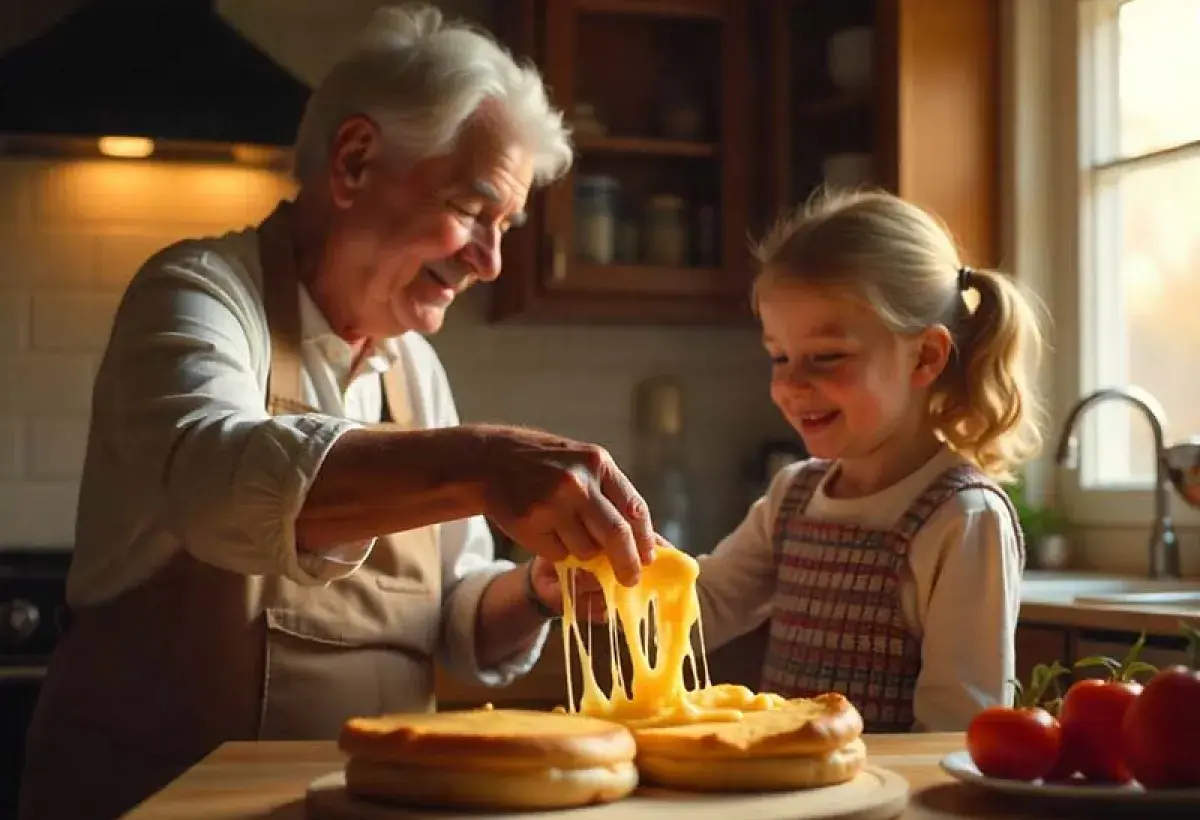
Consider a child watching her grandmother prepare a grilled cheese sandwich.
At first, the memory seems culinary: cheddar, butter, the precise heat of the pan. But over time, the details shift. What remains is not the recipe, but the presence.
Seven uninterrupted minutes of attention.
A small mistake, the butter browning too quickly.
A story, casually told, about making the same meal during a time of scarcity.
What the child receives is not food alone. It is continuity. It is care made visible.
The sandwich becomes a vessel, not of flavor, but of memory.
And memory, when shared, becomes attachment.
Image
The biology of togetherness
The emotional weight of shared eating is biochemical.
Connection, even in its simplest forms, carries a biological imprint. Social interactions. sharing stories, laughter, or a meal are associated with oxytocin, the hormone linked to trust and emotional closeness (Zak et al., 2007). At the same time, the body often shifts out of stress, with cortisol levels decreasing as a sense of ease emerges. What follows is subtle but familiar: tension softens, and openness takes its place.
Even brief shared snacks can shift emotional states. What begins as a simple act of eating becomes a regulation of mood, a reinforcement of trust, and a subtle alignment of internal states.
This is why shared meals often feel restorative. They are not merely breaks from the day they are recalibrations of the self in relation to others.
Three small practices that deepen connection
Connection does not always require grand gestures. Often, it emerges from intentional simplicity.
1. One Plate, Not Two
Sharing from a single plate introduces a form of unconscious coordination. Movements adjust. Timing aligns. The brain mirrors, and through mirroring, empathy grows.
2. Revisit a Memory Through Food
Preparing or sharing a dish tied to personal history activates both emotional memory and relational openness. It invites storytelling, and storytelling invites vulnerability.
3. Sit in Silence Without Discomfort
To eat together without the need to fill space with words is a quiet indicator of emotional safety. It reflects what psychologists describe as “mutual ease”—a state where presence alone is sufficient.
Reflection
We live in an age defined by acceleration. Meals are shortened. Conversations are fragmented. Attention is divided across screens and schedules. In such an environment, shared eating becomes more than a habit as it becomes resistance.
To sit down with another person and share food is to choose presence over distraction, slowness over urgency, and connection over isolation. It is one of the few remaining rituals that require nothing elaborate, yet offer something profound.
Cheese melts and that is certain.
But so do the subtle barriers we carry, the hesitations, the guardedness, the invisible distances between us. Not through grand declarations, but through something far simpler: a shared bite, a passing gesture, a moment of unspoken understanding.
Love, it seems, is not always found in words.
Sometimes, it is found in the space between two people, leaning over the same plate, moving. almost imperceptibly into rhythm with each other. And for a brief moment, that rhythm feels like everything.
Image

About the Author
Clarity Edited writes each word with intention, unfiltered, unsoftened, and without diluting thought. There is no ambiguity, only a quiet effort to bring light to those reading in their darker spaces.
Sources
Dunbar, R. I. M. (2017). Breaking bread: The functions of social eating. Adaptive Human Behavior and Physiology, 3(3), 198–211. https://doi.org/10.1007/s40750-017-0061-4
Zak, P. J., Stanton, A. A., & Ahmadi, S. (2007). Oxytocin increases generosity in humans. PLoS ONE, 2(11), e1128. https://doi.org/10.1371/journal.pone.0001128
Cast Your Vote
Image