A Mother’s Wisdom in a World Upside Down
“We use things and love people, but this era has succumbed to using people and loving things.”
— Inday Ponsa
It was a quiet evening dinner, sinigang, paired with tuyo (dried fish) rice, and the familiar comfort of home when my mother said something I could not unhear.
At the time, it felt like a passing remark. But later that night, as I found myself scrolling through an endless stream of curated lives, perfect smiles, filtered happiness, rehearsed moments, it returned to me with unsettling clarity.
We are more connected than ever.
And yet, we are deeply alone.
Each post feels like a performance.
Each “like” feels like a transaction.
We live in an age of abundance, of convenience, speed, and access, but something essential is quietly slipping away. The question is no longer whether we are progressing. The real question is: What are we losing along the way?
The Silent Crisis Beneath the Surface
This is not simply a cultural shift.
It is a human one.
A growing body of research confirms what many of us already feel but struggle to articulate:
We are starving… not for food, not for wealth, but for meaning, connection, and presence.
A landmark meta-analysis by Holt-Lunstad and colleagues found that chronic loneliness carries health risks comparable to smoking fifteen cigarettes a day. In today’s world, one in three adults report feeling profoundly alone, even when surrounded by hundreds of digital connections.
We have followers.
But no one to sit with us in silence when grief arrives.
Neuroscientific studies further reveal that social isolation activates the same neural pathways as physical pain. The body does not distinguish between a broken bone and a broken bond.
Pain is pain.
The Rise of the Performed Self
In her work on modern culture, Jean Twenge documents a significant rise in narcissistic traits since the late 20th century, fueled by a culture of self-presentation, instant validation, and digital identity construction.
We have learned to curate who we are. But in the process, many have forgotten how to simply be.
The tragic irony is this:
The more we perform our lives, the less we experience them.
Love in the Age of Disposability
Modern technology promised to bring us closer.
Instead, it has made connection easier and commitment harder.
Swipe left. Swipe right. Move on.
Relationships, once seen as sacred and enduring, are increasingly treated as temporary and transactional. For many, love has become something to try, not something to build.
Convenience has replaced commitment.
Choice has replaced depth.
And in a world of endless options, people themselves have become replaceable.
Image
The Emptiness of “More”
Centuries ago, Blaise Pascal wrote that there is an “infinite abyss” within the human heart, one that cannot be filled by anything finite.
Yet today, we try.
We fill it with purchases.
With productivity.
With distractions that promise relief but deliver only temporary escape.
Consumer culture whispers a seductive lie: You will be enough when you have enough.
But beyond basic needs, more does not mean better. In fact, many of the wealthiest societies report some of the highest rates of depression and anxiety.
We are surrounded by things.
But disconnected from meaning.
What We Forgot About Being Human
There was a time, not too long ago, when life moved differently.
Meals were shared, not rushed.
Stories were told, not skipped.
Silence was not uncomfortable, it was sacred.
In the Philippines, traditions like simbang gabi and Sunday family lunches once brought generations together. The bayanihan (bahay-kubo) spirit reminded us that neighbors were not strangers, they were extensions of ourselves.
Today, many families no longer eat together.
Communities are quieter.
Conversations are shorter.
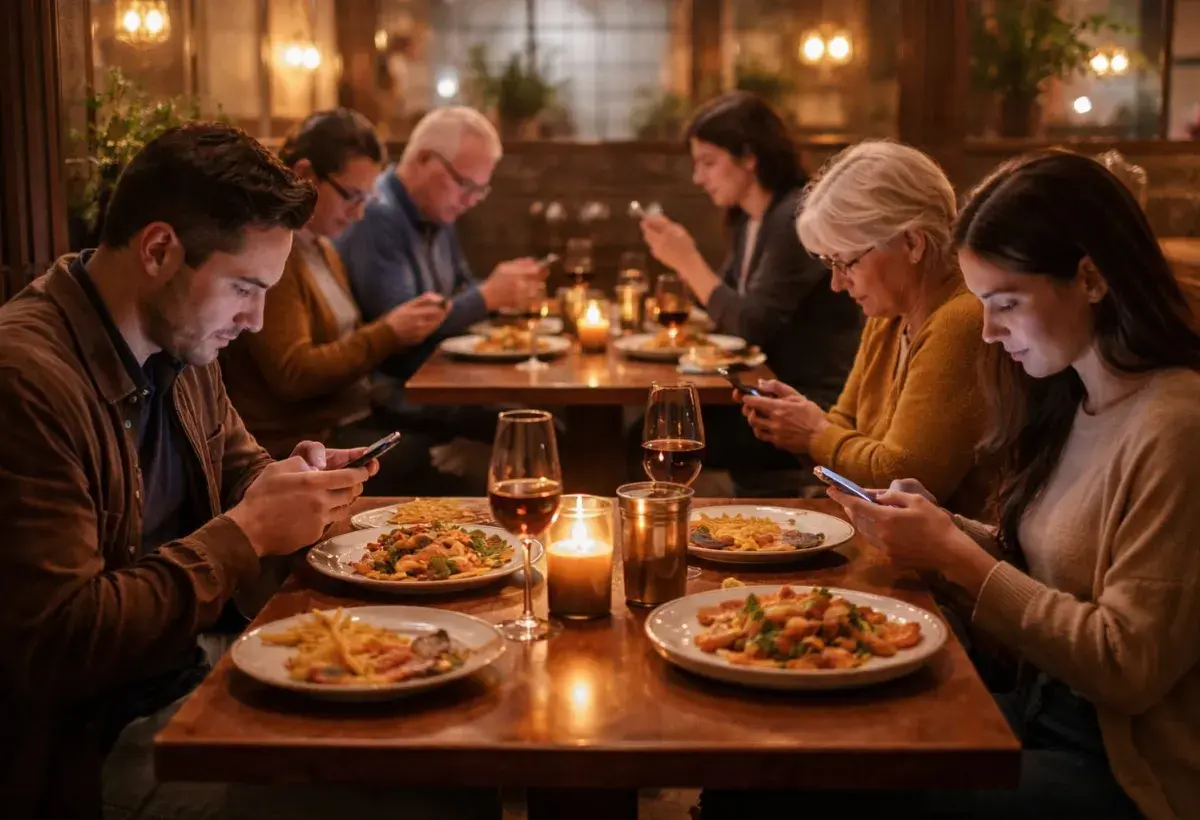
Even when we sit across from one another, a single phone on the table can quietly divide us.
We are present
… but not truly there.
The Disappearance of Community
Sociologist Ray Oldenburg described “third places” as the informal spaces where life happens, cafés, parks, small gatherings, places where connection unfolds naturally. These spaces are disappearing.
Replaced by screens.
By isolation disguised as entertainment.
Where there were once conversations, there are now notifications.
This Is More Than Loneliness
What we are experiencing is not just loneliness. It is what Émile Durkheim called anomie, a condition where the structures that give life meaning begin to dissolve.
It is what Viktor Frankl warned about, a world where the absence of meaning becomes a form of suffering. It is what modern thinkers describe as a quiet collapse of the inner life.
This is not just a personal struggle. It is a shared human condition.
Image

The Cure Is Simpler Than We Think
Not easier.
But simpler.
The answer is not another app.
Not another system.
Not another optimization strategy.
It is something older.
Something slower.
Something deeply human.
Presence.
How We Begin Again
We do not need to fix the entire world. We begin with small, deliberate acts:
- Cook a meal and share it, not for posting, but for presence
- Put away phones and allow conversation to breathe
- Sit with someone in silence without needing to fill it
- Ask an elder to tell their story, and truly listen
- Create spaces however small, where people feel seen, book clubs, coffee or tea gatherings, open neighborhood spaces
These are not grand gestures… but restorations.
The Wealth That Remains
When my mother spoke about loving people and using things, she was not rejecting progress or comfort. She was reminding me of something far more important: That the only wealth that endures is the love we give and receive.
Everything else? status, possessions, digital applause… fades.
But presence stays.
Connection stays.
Love stays.
A Question Worth Sitting With
When was the last time you sat with someone without distraction…
without agenda, without needing to be anywhere else, and simply listened?
Because that is where healing begins and that is where we begin to find our way back.
Image

Suggested Citation
Lendez, M. (2026). What we forgot to hold: Presence, connection, and relational loss in the digital age. Chikicha Digital Publication
References
- Holt-Lunstad, J. et al. – Loneliness and mortality (Perspectives on Psychological Science)
- Twenge, J. M. – The Narcissism Epidemic
- Pew Research Center – Religious and meaning trends
- World Health Organization – Depression and anxiety reports
- Philippine Statistics Authority – Family structure data
- Oldenburg, R. – The Great Good Place
-
Nature Neuroscience – Social isolation studies