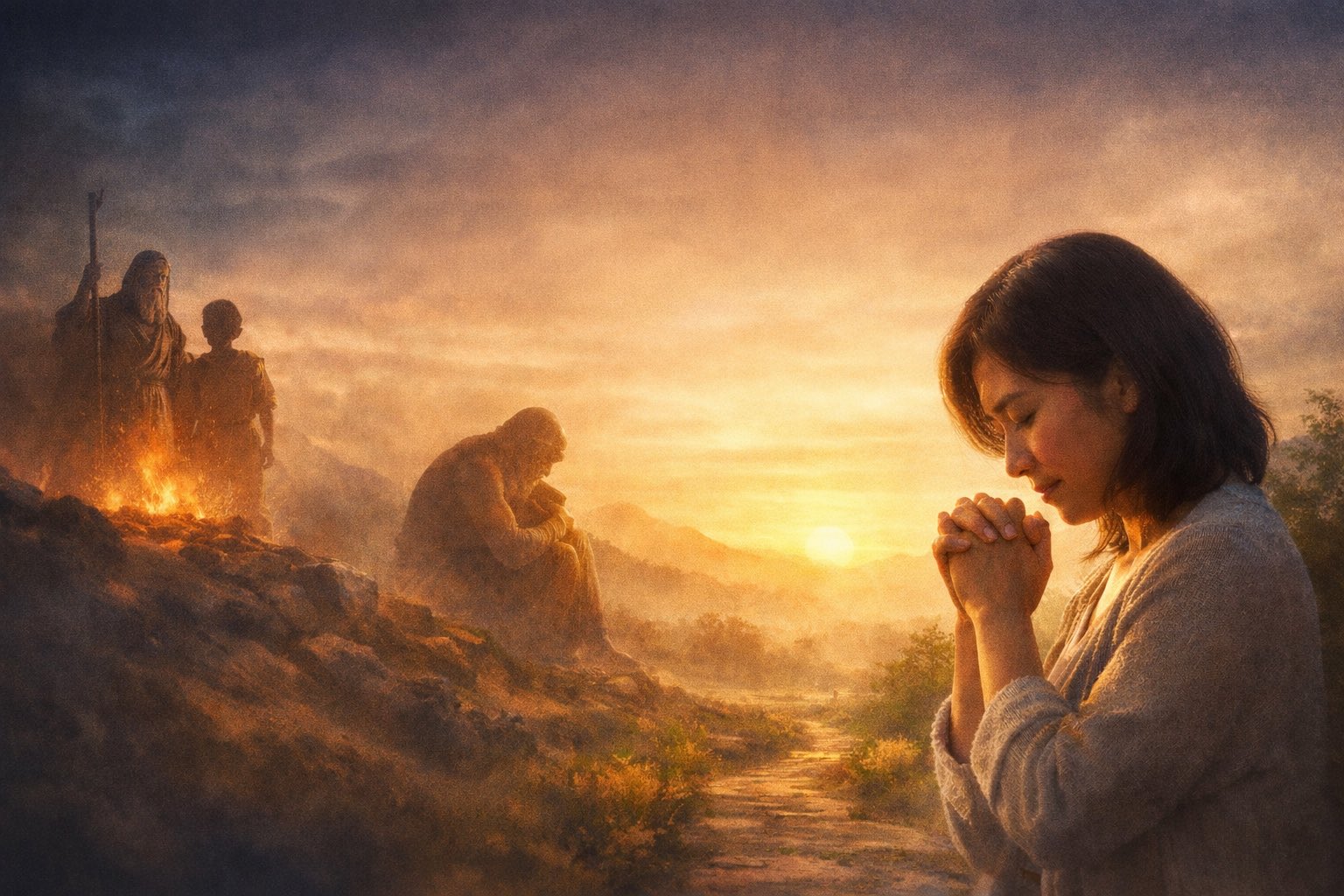
A personal journey through illness, surrender, and choosing faith when life can no longer be controlled.
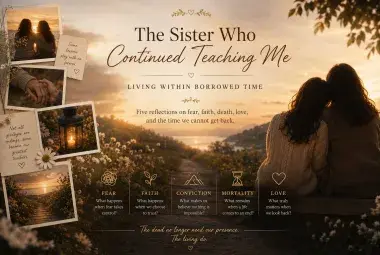
(One chapter in a five-part reflection series chronicling a sister's journey through fear, faith, illness, loss, and the enduring lessons of love. Links to the complete series are provided below.)
What Happens When Life Is No Longer Yours to Control?
What happens when the life you thought you could hold… is no longer yours to control?
There are moments when language begins to fail, when explanation feels insufficient for what the heart is asked to carry. In such moments, even preparation reveals its limits, and one finds oneself standing in a silence that is neither chosen nor easily understood.
silence • overwhelm • the unspoken
Encountering the Limits of Control
When my sister was diagnosed, clearly and unmistakably, with stage III ovarian cancer, the experience was not merely informational; it was existential. The weight of the diagnosis did not arrive as knowledge alone, but as a reality that resisted immediate comprehension.
For more than two months prior, her body had already been engaged in an exhausting struggle. Persistent bleeding, progressive weakness, and the need for near-weekly blood transfusions marked the slow depletion of her physical strength. Her hemoglobin level fell to 53 - a figure that, while clinical in expression, represented something profoundly human: the fragility of life sustained moment by moment.
fragility • endurance • human limits • survival
The Emergence of Surrender
It was within this prolonged space of uncertainty between hospital visits, transfusions, and waiting that a shift occurred. Not toward certainty, but toward surrender. She spoke not from resolution, but from relinquishment:
“How do I measure the value of my life, Lord? It was never mine. You have mercifully sustained this breath of life. I am Yours. With great confidence, I trust You… so please take care of me.”
There are prayers that seek answers, and there are prayers that yield everything. This was unmistakably the latter.
offering • surrender • faith • belonging
Abraham and the Theology of Surrender
In reflecting upon her words, one is drawn into the narrative of Abraham, a figure whose faith is not defined by clarity, but by obedience in the absence of it.
In Genesis 22:2 (New International Version), the command is given:
“Take your son, your only son, whom you love, Isaac, and go to the region of Moriah. Sacrifice him there as a burnt offering on a mountain I will show you.”
This text resists easy interpretation. It does not comfort; rather, it confronts. It presents a demand that appears to contradict both reason and emotional attachment. Yet, the narrative does not dwell on Abraham’s internal dialogue. Instead, it records his response: he rises early and proceeds (Genesis 22:3).
What emerges is not blind faith, but a form of trust that transcends understanding… a trust not contingent upon outcome, but grounded in relationship.
obedience • surrender • uncertainty • trust
Faith Beyond Explanation
This raises a critical question: What kind of faith persists when outcomes are not only unclear, but potentially devastating?
Such faith cannot be reduced to optimism or positive expectation. Rather, it is characterized by a willingness to move forward despite the absence of assurance. It is, fundamentally, a relational trust.
uncertainty • courage • faith • trust
Image

Job and the Endurance of Faith
A parallel articulation of this form of faith is found in the narrative of Job. Having lost his wealth, his health, and his children, Job’s experience represents one of the most comprehensive portrayals of human suffering in biblical literature.
In Job 13:15 (New International Version), he declares:
“Though he slay me, yet will I hope in him.”
This statement is neither passive nor naïve. It emerges from the depths of suffering and reflects a conscious decision to maintain trust in the absence of restoration. Job’s faith is not sustained by favorable circumstances, but by a conviction that persists even when those circumstances collapse.
loss • endurance • hope • resilience
Reframing Surrender
Within this theological framework, my sister’s words take on a deeper significance. Her statement, “It was never mine… I am Yours”, is not an expression of defeat, but of reorientation. It reflects a movement from possession to entrustment, from control to relationship.
entrustment • surrender • belonging • release
The Reality of Fear and the Presence of Peace
It must be acknowledged that surrender does not eliminate fear. Fear remains present in the uncertainty of prognosis, in the experience of physical pain, and in the limitations imposed by the body.
However, alongside fear, there emerges another presence: a quiet, steady inner voice that does not negate fear, but repositions it. This voice does not provide immediate answers, but it offers orientation, guiding the mind away from internal conflict toward a state of trust.
In this sense, faith does not function as an escape from fear, but as a means of coexisting with it without being consumed.
fear • reality • inner peace • trust
Living Without Illusions of Control
Contemporary life often reinforces the notion that control is attainable through planning, discipline, and strategic action. Illness, however, disrupts this assumption. It reveals the inherent limitations of human control and invites a reassessment of what it means to live meaningfully.
What remains, when control is stripped away, is the capacity to choose one’s posture.
control • illusion • awakening • choice
Faith as a Lived Practice
Faith, in this context, is not merely a belief system, but a lived practice. It is expressed in the decision to trust, to hope, and to remain open even in conditions that do not guarantee resolution.
When my sister said, “take care of me,” she was not relinquishing responsibility in a passive sense. Rather, she was actively choosing to place her life within a framework of trust that extended beyond her immediate understanding.
faith • surrender • trust • practice
Conclusion: The Question That Remains
The question, therefore, is not simply why life ends, but how one chooses to live within its uncertainty. If life was never fully ours to control, then perhaps its meaning lies not in securing outcomes, but in cultivating trust.
life • mortality • meaning • reflection
Closing Reflection
How will you live when life is no longer yours to control?
The answer may not be found in certainty, nor in strength alone, but in the quiet and persistent act of surrender, a surrender that does not negate fear, but is accompanied by a faith that remains.
Quiet.
Unshaken.
And real.
faith • surrender • peace • trust
Image

About the Author - The Listening Pen
The Listening Pen writes not from certainty, but from quiet attention. She moves through life one step at a time, learning to pause, to notice, and to listen, not to the noise of the world, but to the gentle whispers within her own heart. It is in these unguarded moments, where reflection meets honesty, that her words begin to take shape. She does not claim to have all the answers, but she chooses to remain present, to feel deeply, and to translate those inner stirrings into thoughts that may resonate with others walking their own unseen journeys. In listening, she understands. And in understanding, she writes.
Part One: Why Will You Die? A Reflection on Fear, Framing, and the Gift of a New Heart https://reflections.chikicha.com/why-will-you-die-part-one-reflection-fear-framing-and-gift-new-heart
Part Two: Why Will You Die? Part Two. A Reflection on Trust When Life Is No Longer Ours to Control https://reflections.chikicha.com/why-will-you-die-part-two-reflection-trust-when-life-no-longer-ours-control
Part Three: Nothing Is Impossible https://reflections.chikicha.com/nothing-impossible
Part Four: The Space of This World in Humanity: A Reflection on Death, Presence, and the Borrowed Time We Live In https://reflections.chikicha.com/space-world-humanity-reflection-death-presence-and-borrowed-time-we-live
Part Five: The Friend I Never Became: What my sister's death taught me about love, presence, and the time we cannot get back https://reflections.chikicha.com/friend-i-never-became-what-my-sisters-death-taught-me-about-love-presence-and-time-we-cannot-get